NetherOS.
The operating layer behind the workshop.
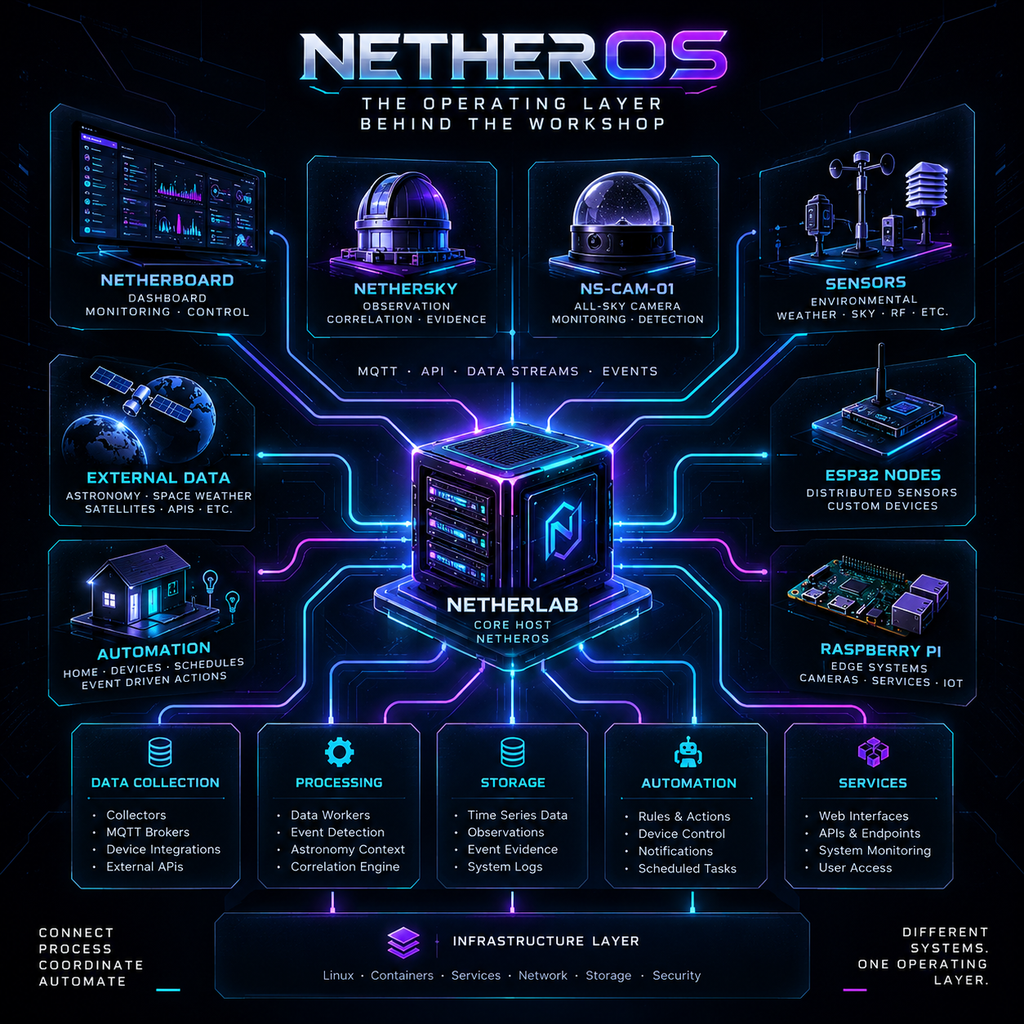
NetherOS is the software and infrastructure layer behind NetherViking’s connected systems. It brings services, data, automation and processing together so individual projects can operate as parts of a larger ecosystem.
From sensor data and messaging to event processing and system coordination, NetherOS provides the common foundation on which systems such as NetherSky can run, communicate and evolve.
Connect · Process · Coordinate · Automate
What is NetherOS?
More than an operating system.
NetherOS is not intended to replace Linux or act as a traditional desktop operating system. It is the operating environment I am building on top of existing hardware, operating systems and services to connect the different parts of the NetherViking workshop.
Instead of every project becoming its own isolated collection of scripts and services, NetherOS provides a shared layer where data can be received, processed, stored and passed between systems.
Its purpose is to turn separate devices and applications into parts of one larger architecture while still allowing each project to develop independently.
Different systems. One operating layer.
What does it do?
Moving data from observation to action.
NetherOS sits between the devices producing data and the systems that need to do something with it. It provides the infrastructure for communication, collection, processing and coordination across the workshop.
Within NetherSky, for example, sensor measurements and camera observations can arrive through different paths. NetherOS provides the environment in which collectors, workers and contextual services can process that information and bring it together for correlation and event evidence.
MQTT provides part of the messaging backbone, while dedicated processes handle specific tasks such as data collection, astronomy context and evidence building.
The same philosophy can extend beyond NetherSky. Rather than rebuilding the underlying infrastructure for every new experiment, new systems can eventually make use of the services NetherOS already provides.
Receive → Process → Correlate → Store → Act
Where does it run?
NetherLab is the machine. NetherOS is what makes it work.
The primary home of NetherOS is NetherLab, the central host behind much of the NetherViking infrastructure.
But NetherOS is not limited to a single computer. The systems it coordinates extend outward to ESP32 sensor nodes, Raspberry Pi systems, cameras and other devices distributed throughout the workshop.
Those nodes can perform their own specialized tasks while NetherLab provides the central environment for services that benefit from shared processing, communication and storage.
That makes NetherOS less about where one program runs and more about providing a common operating layer across an increasingly distributed collection of systems.
NetherLab at the core. Specialized nodes at the edge. NetherOS connecting the two.
NetherOS in practice.
The operating layer becomes useful when systems start working together.
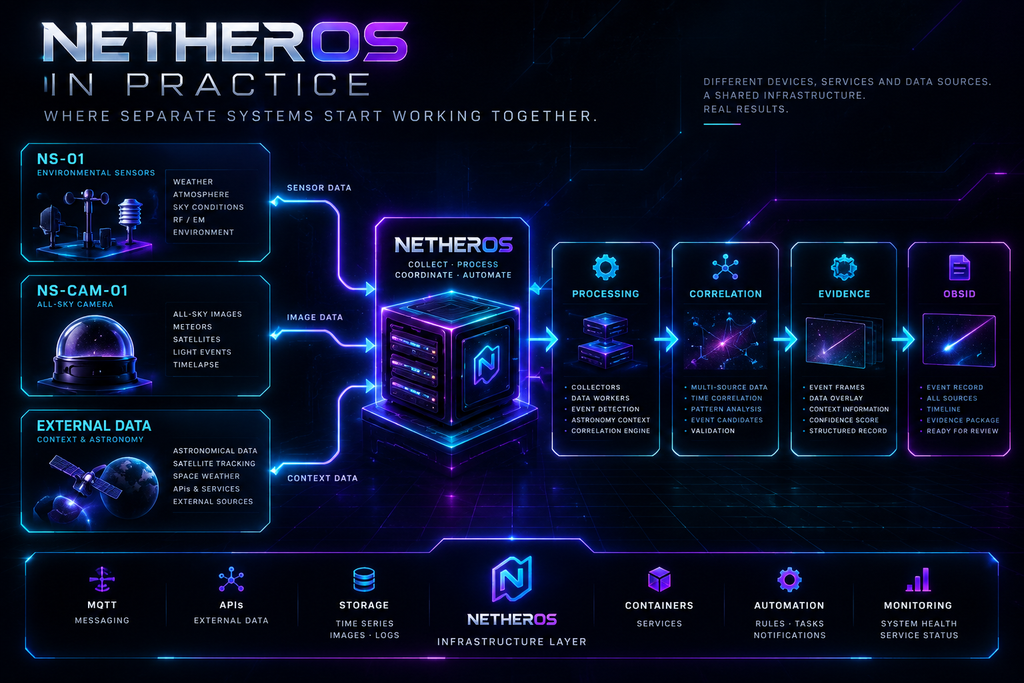
NetherOS becomes most visible when different devices, services and data sources need to work together. Instead of building a separate backend for every experiment, common infrastructure can be shared while each project keeps its own purpose and identity.
NetherSky is a good example. NS-01 produces environmental and optical measurements, NS-CAM-01 provides visual observations, while astronomical context and other data arrive from separate sources. NetherOS provides the environment in which these different streams can be collected, processed and connected.
Dedicated collectors and workers handle individual tasks, while MQTT provides part of the communication layer between systems. From there, observations can move through correlation and evidence building, eventually becoming part of a structured OBSID event record.
The important part is that the individual components do not need to understand the entire system. A sensor can measure. A camera can capture. A service can calculate context. NetherOS provides the layer that allows those specialized parts to contribute to something larger.
As new projects and services are added, the same approach can be reused rather than rebuilding the foundation each time.
Specialized components. Shared infrastructure. Connected by NetherOS.
Where NetherOS is going.
Building the foundation for whatever comes next.
NetherOS started as a way to connect the growing collection of systems behind NetherViking. As those systems become more capable, the role of NetherOS can grow with them.
The long-term direction is a shared platform where new projects can make use of existing communication, storage, processing, automation and monitoring instead of rebuilding those foundations from scratch.
That also means becoming increasingly modular. New sensors, services and applications should be able to join the ecosystem without requiring everything around them to change. A new project should only need to understand the services it uses, while NetherOS handles the common infrastructure underneath.
Over time, more intelligence can move into that shared layer. Events from different systems can trigger workflows, observations can provide context to other projects, and information collected for one purpose may become useful somewhere completely unexpected.
NetherOS does not need to become one enormous application controlling everything. The goal is almost the opposite: keep individual systems specialized while giving them a common foundation on which they can communicate, cooperate and evolve.
There will always be another device to connect, another service to build and another experiment that needs somewhere to run.
Build the foundation. Connect the systems. Let the workshop evolve.
NetherViking.
Build it. Understand it. Question it. Evolve it.
© 2026 NetherViking. Built for experiments, systems and everything in between.