NetherSky.
Autonomous observation of the sky and the environment around it.
NetherSky is a continuously evolving observation platform built to measure, capture and understand changes in the sky. It combines sensors, imaging and environmental data into a single autonomous system designed for long-term observation and experimentation.
Observation · Light · Weather · Astronomy · Imaging
● SYSTEM ACTIVE
What is NetherSky?
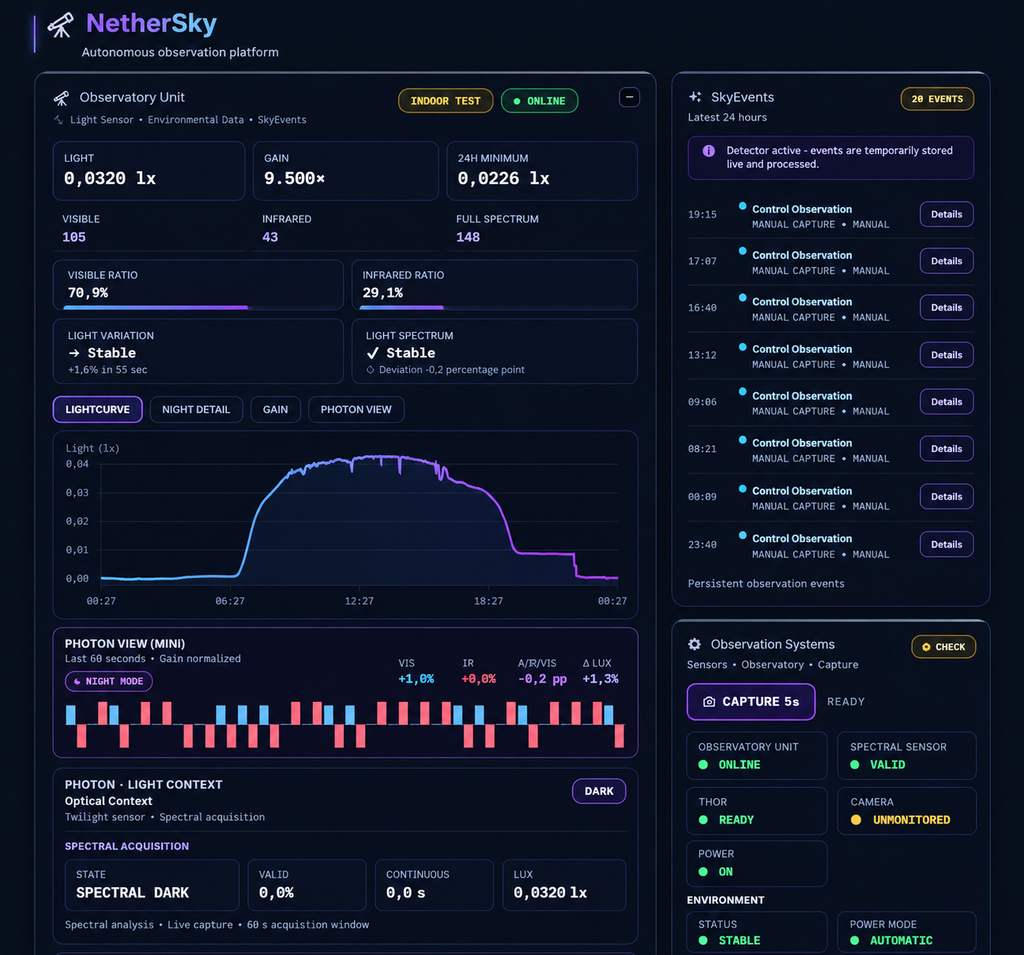
NetherSky is a self-built observation platform designed to continuously monitor the sky and its surrounding environment.
Rather than relying on a single sensor or camera, NetherSky brings multiple types of observations together. Light levels, environmental conditions, optical measurements and imaging can be collected over time and viewed as part of the same system.
At its core, NetherSky is an experiment in continuous observation. The goal is not simply to collect data, but to discover how different measurements relate to each other and what becomes visible when a system keeps watching long after I have stopped.
The platform is designed to evolve. New sensors, cameras and detection systems can be added as the project grows, turning NetherSky into an increasingly capable observation network.
Built to observe. Designed to evolve.
How NetherSky Works.
NetherSky continuously collects observations from different sensors and imaging systems and brings them together in one platform.
Each part of the system watches a different aspect of the environment. Sensors measure changing conditions, optical instruments observe light, and imaging systems provide a visual record of what is happening above.
These measurements are collected over time and processed by NetherSky, where they can be compared, visualized and used to detect interesting changes or events.
The important part is that the system does not depend on someone actively watching it. NetherSky is designed to operate autonomously, continuously building a record of the sky and its environment.
When something interesting happens, the different observations provide context for each other rather than existing as isolated measurements.
Observe → Collect → Correlate → Detect
Inside NetherSky.
NetherSky is built around three main components: a sensor node, an imaging node and the backend that brings their observations together.
NS-01.
Environmental & optical sensing. The primary sensor node of NetherSky. Built around an ESP32, NS-01 continuously collects measurements from five different sensors.
AS3935 · Lightning detection / THOR
BMP388 · Atmospheric pressure
TSL2591 · Low-light measurement
LTR390 · UV measurement
AS7341 · Spectral measurement
NS-CAM-01.
Visual observation
The imaging node of NetherSky, built around a Raspberry Pi Zero 2 W and a Raspberry Pi Camera Module 3 Wide NoIR.
Its role is to provide visual evidence that can be correlated with sensor measurements and detected events.
NetherLab driven by NetherOS.
Processing, correlation & Operating System
NetherLab, driven by NetherOS, provides the backend infrastructure behind NetherSky. Sensor measurements, camera captures and contextual information come together here for processing, correlation and event evidence.
NS-01 + NS-CAM-01 + Context –> Correlation Engine –> Event Evidence –> Classification (OBSID)
THOR.
Storm & lightning detection.
THOR monitors lightning activity using NetherSky’s AS3935 sensor and combines detected events with weather and environmental context.
MOONLIT.
Measuring moonlight.
MOONLIT explores whether moonlight can be reliably detected in NetherSky’s sensor data by combining light measurements with astronomical context.
NS-CAM-01.
Visual evidence.
NS-CAM-01 is NetherSky’s imaging node, capturing visual evidence that can be correlated with sensor measurements and detected events.
PROJECT THOR.
Understanding storms through correlated observations.
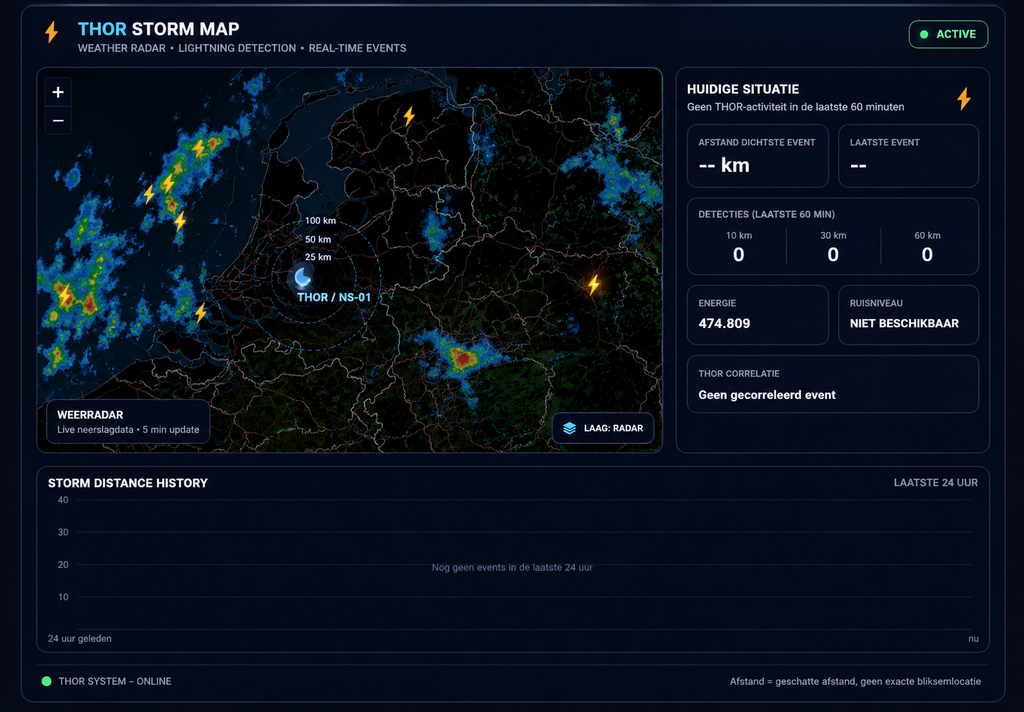
THOR is NetherSky’s dedicated storm and lightning observation system. It starts with lightning activity detected by the AS3935 sensor, where every physical detection becomes a raw THOR event that can be recorded and examined alongside the rest of NetherSky’s observations.
Rather than treating lightning as an isolated measurement, THOR brings each event into NetherSky’s Correlation Engine. Atmospheric conditions, changes in light, spectral measurements and visual evidence from NS-CAM-01 can all provide additional context around the same moment.
This makes it possible to investigate what NetherSky observed before, during and after a detected event. A lightning strike may appear clearly in one sensor while leaving little or no measurable response in another. Both results are useful, because the absence of correlation can be just as important as a positive match.
THOR also maintains a history of detected events and provides the data used by the Storm Map. Distance information from the sensor can add spatial context to an event, while NetherSky deliberately avoids inventing directional information that the hardware itself cannot measure.
The long-term goal is to turn individual lightning detections into documented storm events, combining sensor data, environmental context and visual evidence into a record that can be explored long after the storm has passed.
Detect the strike. Correlate the evidence. Understand the event.
PROJECT MOONLIT.
Finding the Moon in the data.
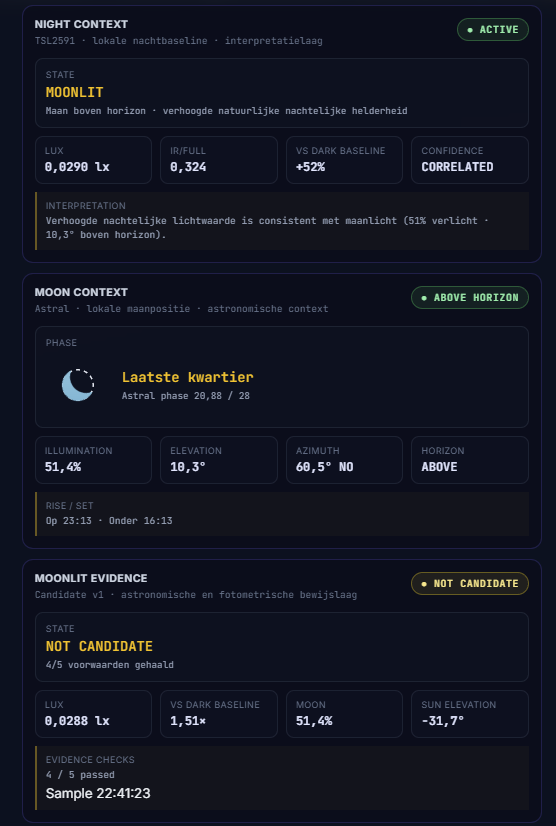
MOONLIT explores a deceptively simple question: can NetherSky actually measure the influence of moonlight? Rather than assuming that a visible Moon automatically means measurable moonlight, the system looks for evidence in the observations themselves.
The TSL2591 provides sensitive measurements of the night sky, while astronomical context determines where the Moon and Sun are at that moment. Moon elevation, illumination and the darkness of the sky can then be compared with changes in measured light levels.
MOONLIT separates context from evidence. A night can be classified as moonlit while still failing the stricter requirements for a candidate event. This allows NetherSky to distinguish between an expected astronomical situation and a measurement that actually provides enough evidence to investigate further.
Over time, these observations can help establish a better understanding of the local night baseline and how it changes under different lunar conditions. Spectral and other sensor measurements can eventually provide additional context when an interesting light response is detected.
The goal is not simply to calculate when the Moon should be visible. That information is already known. The experiment is to discover whether NetherSky can independently recognize its measurable effect in the environment.
Know where the Moon is. Measure its light. Find it in the data.
PROJECT NS-CAM-01.
Giving sensor events visual evidence.
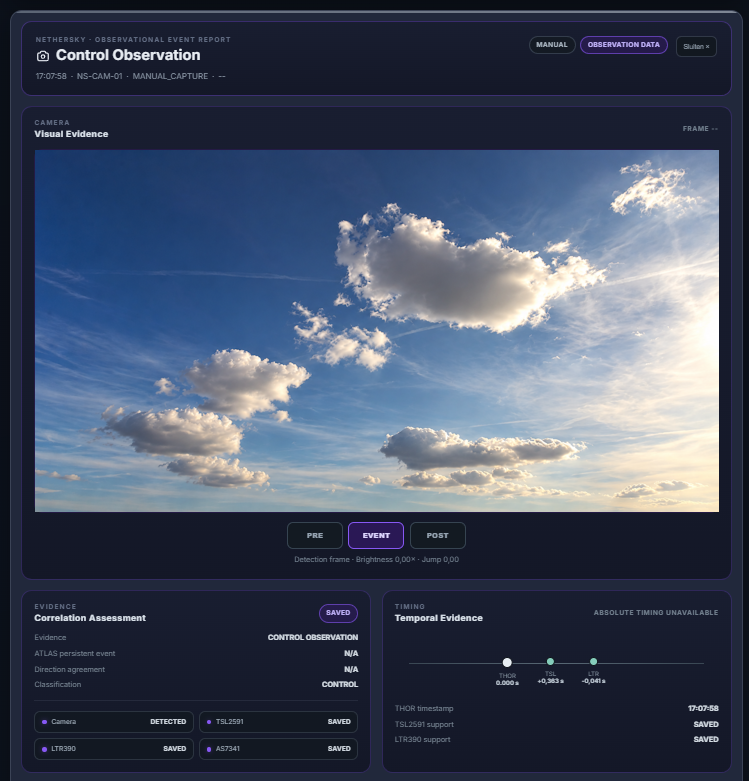
NS-CAM-01 gives NetherSky a visual record of what was happening when its sensors detected something interesting. Built around a Raspberry Pi Zero 2 W and a Camera Module 3 Wide NoIR, its role goes beyond simply capturing images of the sky.
When an observation is recorded, camera evidence can be placed alongside measurements from NetherSky’s light, UV and spectral sensors. Instead of looking at an image or sensor response in isolation, the system can examine what multiple instruments observed around the same moment.
This creates an event window in which visual evidence, sensor responses and timing can be compared. A change seen by one instrument may be supported by another, while a missing response can be equally useful when determining what an event was not.
The goal is to turn a camera capture into more than a photograph. NS-CAM-01 provides the visual piece of an evidence chain that NetherSky can correlate, preserve and eventually use to classify observations.
See the event. Correlate the sensors. Preserve the evidence.

Sensor Correlation & Photon Fingerprint.
Turning simultaneous measurements into a single observation.
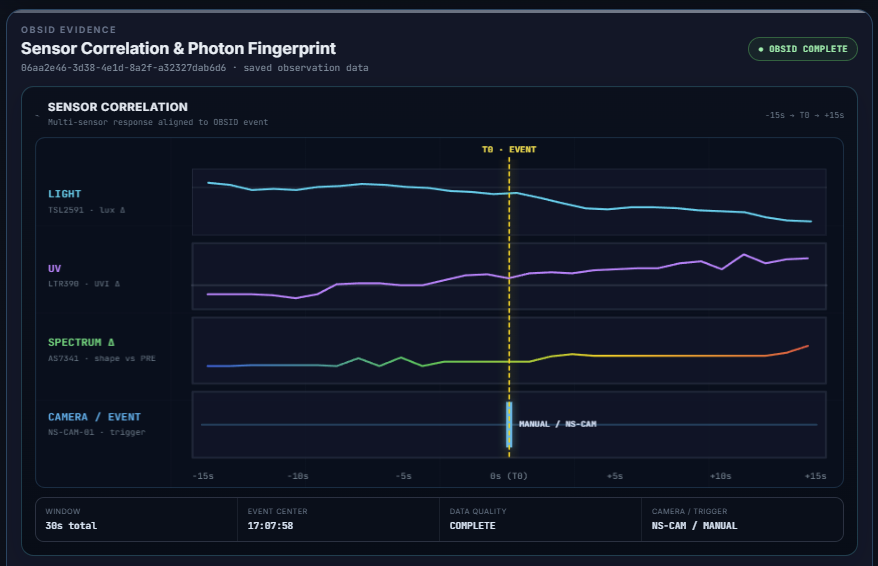
When NetherSky records an event, the camera is only one part of the evidence. Measurements from the light, UV and spectral sensors are preserved around the same moment, allowing the system to compare how different instruments responded to the same observation.
The Sensor Correlation view places these responses on a shared timeline around the event. This makes it possible to see whether changes in visible light, UV or spectral measurements occurred before, during or after the camera observation, rather than treating each sensor as an isolated source of data.
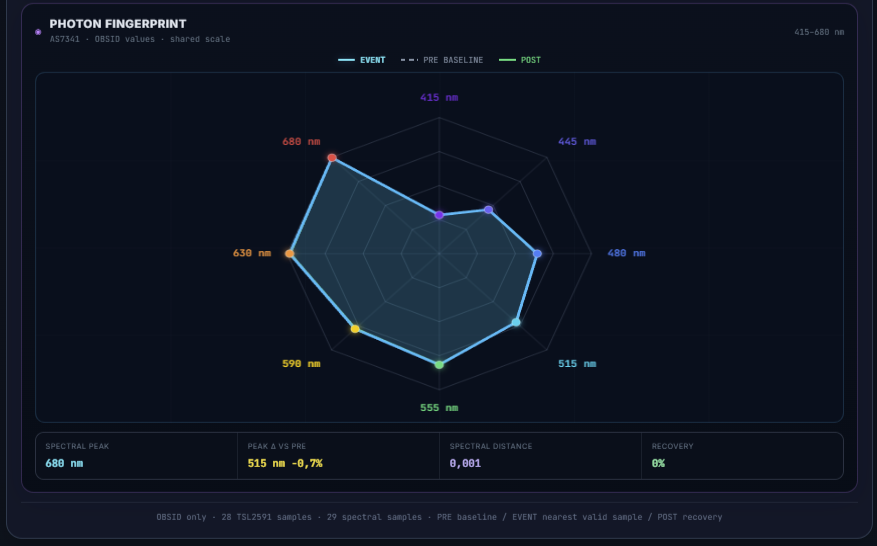
The Photon Fingerprint adds another dimension. Using measurements from the AS7341, NetherSky records how the observed light is distributed across its spectral channels. Instead of describing an event only by how bright it was, the system can preserve something closer to its optical signature.
Together, these measurements form part of the OBSID evidence record. The purpose is not to force every sensor into agreement, but to preserve what each instrument actually observed. A strong correlation is useful evidence, but a sensor that shows no response can be just as informative.
Over time, these fingerprints can be compared across observations, providing a foundation for distinguishing recurring patterns and investigating whether different events produce recognizably different sensor responses.
One event. Multiple sensors. One preserved fingerprint.
Where NetherSky is going.
NetherSky is not intended to become a finished instrument with a fixed set of capabilities. It is being built as an observation platform that can grow as new sensors, cameras and ideas become part of the experiment.
The next step is not simply collecting more data. It is improving how observations are connected. THOR, MOONLIT, NS-CAM-01 and the environmental sensors each provide a different view of what is happening, but their real value emerges when those observations can be brought together around the same event.
OBSID is part of that direction. By preserving sensor responses, visual evidence, timing, astronomical and atmospheric context together, NetherSky can build increasingly complete records of interesting observations instead of reducing them to a single measurement or classification.
Over time, those records can be compared. Recurring sensor responses, spectral patterns and correlations may reveal similarities between events, while differences and missing correlations remain part of the evidence rather than being discarded.
The ambition is not to make NetherSky automatically claim what happened. It is to build a system capable of collecting enough independent evidence to make increasingly informed classifications while keeping the original observations available for inspection.
NetherSky will continue to evolve as the observations themselves raise new questions, because every answer tends to produce another experiment.
Observe more. Correlate better. Preserve the evidence. Keep asking questions.
NetherViking.
Build it. Understand it. Question it. Evolve it.
© 2026 NetherViking. Built for experiments, systems and everything in between.